


“Machines will never be able
to generate a work of art using software, because art is the
result of feelings - something a computer will never accomplish“
⁓ Petrus Wandrey, 2002

Petrus Wandrey proclaimed Digitalism in New York in 1978 and worked in it until his death in 2012.
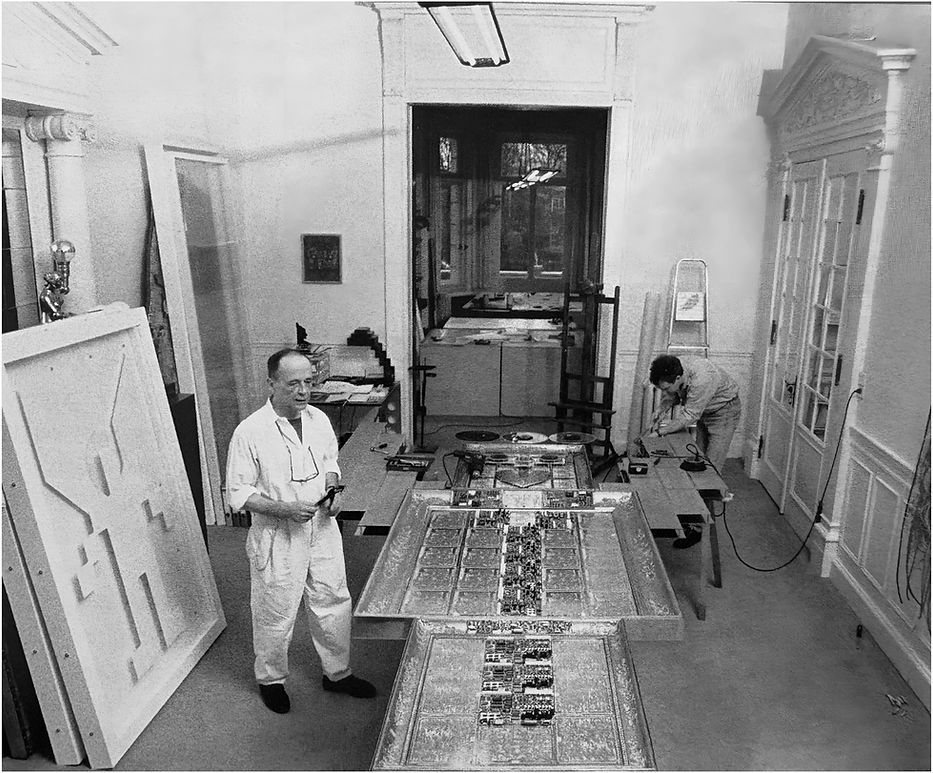
He took the pixel as a script and wrote in it by hand, in airbrush, screenprint, circuit board, and steel.
His material came from an atomic clock, from NASA photographs of Mars, and the chip plants of Philips.

Discover DIGITALISM
This section offers an overview of Petrus Wandrey’s artistic production, presenting works on canvas and paper alongside mixed-media constructions, installations, and sculptures. His multifaceted oeuvre, comprising around 3,000 individual works, evolves from early influences rooted in Surrealism and Pop Art toward his distinct visual language, DIGITALISM.


Context
German philosopher Bazon Brock wrote on the work for Spiegel special in 1995, and the American art critic David Galloway curated the Leipzig retrospective of 1999 and wrote the monograph that remains the fullest account of his life and the oeuvre.
The New York Times, the Times of Israel, and Die Zeit reported.
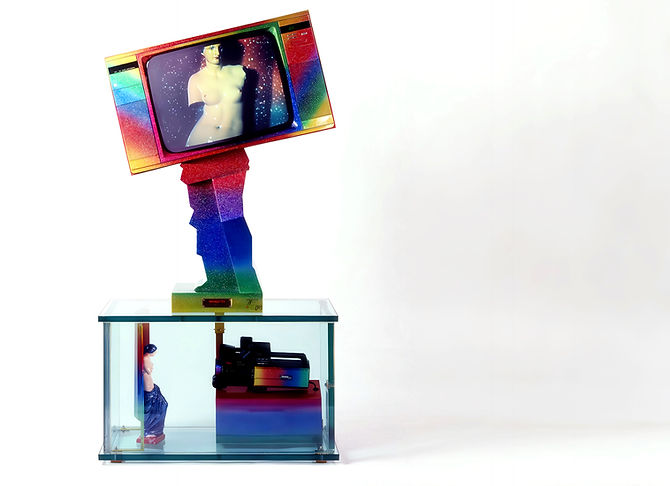


In May 1975, Wandrey carried Venus' Wind to Port Lligat in two parcels, a birthday present for Salvador Dalí.
The gilded Venus wears two Siemens fans where her arms broke off. Police had held him at Hamburg airport, taking the golden figure for stolen. It entered the Mae West Room of the Teatre-Museu Dalí in Figueres, where it stands today.
Dalí gave him a sentence instead of praise. Surrealism is an invention of my generation. You must create your own, new direction in art for your generation. Wandrey went back to Hamburg, emptied the studio, and destroyed a large part of everything he had made until then.
Three years later, he found the answer in New York. He proclaimed Digitalism in 1978 with Science and Beyond, and spent the next decades creating in that new language.
The Dalí Instruction
Venus’ Wind, 1973
This site is the archive. It publishes the biography from the documented record, the works on canvas and on paper, the constructions and the sculptures, the exhibition history and the critical reception, and reports current projects.
The work is being catalogued so that it can be studied, lent and shown. Enquiries from museums, curators, researchers and collectors are welcome.
Sources: David Galloway, Petrus Wandrey – Bilder, Skulpturen, Objekte, Oktagon, Cologne 1999. Bazon Brock, Heartware, in: Spiegel special 3/1995. Andreas Grosz (ed.), Petrus Wandrey – Digitalismus, Braunschweigisches Landesmuseum 1990. Estate records, Sabatier.